

Authors, don't fall for this scam
How con-artists are using AI, Goodreads, and pirated books to find their marks
Last week I posted a piece about why writers shouldn’t ignore reviews on lowly sites like Goodreads, etc. Interestingly, just a couple of minutes after hitting send, I received an email that made me question the wisdom of my advice.
The sender claimed to be an “Author Visibility Strategist” who happens to run a 35,000-member reading group on Goodreads; in the email there were links to what appeared to be a professional website and to the group’s page.1 The website was an obvious red flag,2 but the Goodreads group seemed legit, and right at the top of their home page was the following warning:

So the setup was clear enough. What confused slightly me was that the email made no mention of money. Here’s the full text:
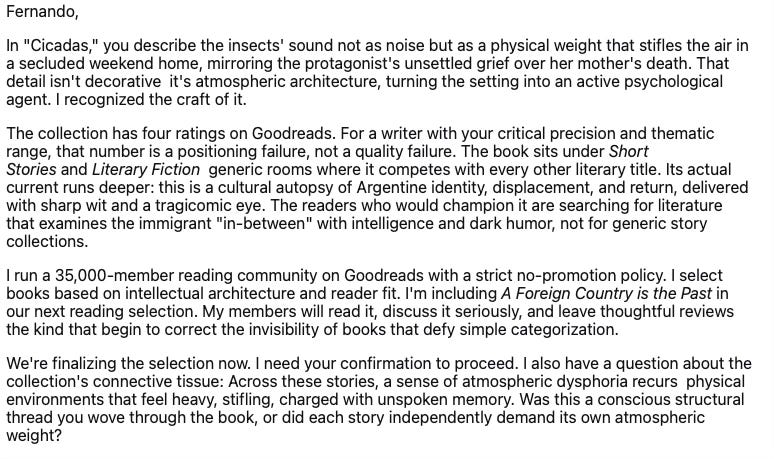
As you can see, no money talk. But if the AI-sculpted tone of the email, its opening flattery pivoting to a problem and a hinted solution, the vagueness of the proposal, and the closing engagement question don’t make it clear this is a scam, I don’t know what would. Since I was curious to see where the imbroglio was going, I replied anyway, saying that of course they could feature my book. And I even briefly entertained their craft question. After all I’m an author — therefore starved for attention — and this was someone who had read my book. Who am I to judge my readers’ morals?
Sure enough, another message arrived ten minutes later. This one, to keep it brief, informed me that the “feature [was] locked” and that members of the group would soon start posting their impressions, plus some more brown-nosing about my literary choices. Then they moved straight into the scam, offering me a “no-obligation analysis of the three specific discoverability levers that would reposition the collection for the readership it deserves;” this, they said, was separate from the group and the feature was happening anyway. I replied, saying that I would mention it to my publishers, and get back in touch if they were interested, that for now I was looking forward to reading what the members made of the book. They came back minutes later saying that they understood, no problem at all. There was silence for a week. A couple of days ago they sent a follow-up email:
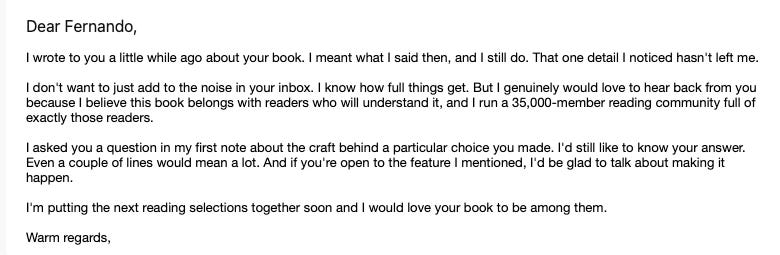
Here the scammer shows that they might suffer from short term memory loss, or rather, that they are running this con on many writers at once and can't keep track: they are asking me to answer a question I already answered, and the feature isn’t locked any more. I’m sure you can see how this works: they bait you, get your hopes up, and only then go for the ask. In other words, the old “the first one is free, the second one is paid for,” of your regular drug dealer.
What makes this exchange even more interesting is that this wasn’t the only scammer who got in touch these past few days. Over the weekend, another AI-churned email arrived, again from an alleged Goodreads user running a reading group.3 I won’t bore you to death with too many details — it’s basically more AI slop, more praise for the “atmosphere” of my stories, more jargonese — “reading cycles,” “features”, and “next steps forward.” To have some fun with this one, I replied using an AI bot, and I exchanged several ridiculous emails back and forth. This dialogue between machines had some beauty to it, I must admit. For example:
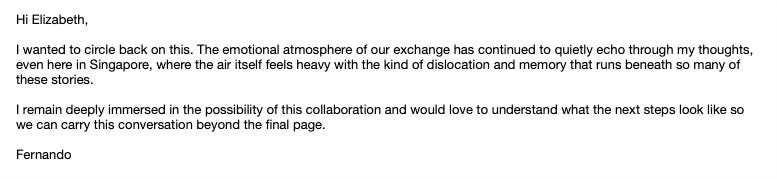
After four or five messages I got bored and blocked them.
A third email — from another alleged Goodreads reading group moderator — landed this morning. I won’t even bother with that one here, since it’s just more of the same. I expect more scammy missives to arrive in the future too.
#
Any writer who’s been in the game long enough knows that literary cons are aplenty and that most start in the same way — telling you how great you are. I remember when I was a naïve young wannabe-auteur and sent my first, horrible attempt at a book to a Spanish vanity publisher I had taken for the real thing — they came back with similar generic praise and a request for €3,000 to publish me. Plus ça change, plus c'est la même chose. What makes this new scam remarkable in any way is their artful use of technology. And I don’t mean the AI-generated emails — that part of the operation is very sloppy — but the fact that they sounded like they knew my book. And to some extent, they do.
Because a couple of weeks ago I learned that the book in question has been pirated and is available on a very strange site. After some thought, I’m now pretty certain the scammers got hold of this version and crawled it using AI to get a few lines that make it sound like they read it. If you look at the opening email (Exhibit A), you will see this clearly: the opening two paragraphs are specific to my book, even mentioning one of the stories by name; the rest is a generic copy-paste job, with a couple of tweaks here and there. Their amnesiac follow-up email (Exhibit B) is 100% generic nonsense — the kind of message they must send en masse to marks when the communication has gone quiet. Clever little scam they’ve got going, don’t you think?
Anyway, be careful out there, especially if you’ve had a book published or pirated in recent times.4 Sadly, it seems not even scammers read books these days.
But hey, at least AI does.
P.S. If you appreciate this PSA, contribute to my own literary scam by getting a premium subscription to this newsletter, tossing some coins my way, or buying my latest book.
I won’t link to the reading group or fake website, to avoid causing additional problems for those being impersonated.
Free web address, generic and excessive marketing glossolalia, unclear services, anonymous testimonials, and I could go on.
The name and photo used by the scammer actually matched the name and photo of one of the group moderators on Goodreads.
How did they get hold of my personal email address, which I don’t use for anything literary? I suspect they found it in a data leak. Since I know of only one other Fernando Sdrigotti, and he’s not a writer, joining the dots must have been easy for them.